Sunday, October 23, 2016

Delays in national pride projects set a poor example

Lack of farsightedness, planning, ambiguous policies and weak implementation over the years has left projects in a bad state


Sujata Awale

Kathmandu

The performance of national pride hydropower projects are far behind schedule due to lack of legal incentives, special rules and regulations to smoothly run these projects. According to the report of the Office of the Auditor General (OAG), the budget allocated for national pride projects are not spent and the development of projects are not as expected.

The government has announced three hydropower projects — Upper Tamakoshi, Buddhigandaki and West Seti as national pride projects with huge importance and impact on the nation. Except for Upper Tamakoshi 456 MW run-of-the-river project, both storage projects Buddhigandaki 1,200 MW and West Seti 715 MW are performing badly.

Lack of proper attention, special provisions and policies, minimising of hurdles, prioritisation and strong political will to develop these projects are the main reasons for slow development. Moreover, lack of farsightedness, planning, ambiguous policies and weak implementation in yester years resulted in the present poor state of these national pride projects.

The government identified 21 projects as ‘national pride’ projects considering the impor¬tant role they could play on the socio-economic development of the country. To ensure early completion of these projects, the government has also pledged to remove all hurdles in the way of their implementation. However, the government and concerned authorities have proved once again that they are big on talk and low on delivery.


STILL ON PAPER


The government announced Budhigandaki as a national pride project in the fiscal year 2013-14. The project was to be completed by 2019-20, however, there has been no work done physically. According to the OAG report, physical evelopment is nil and of the total estimated cost of Rs 255 billion, only Rs 1.22 billion was spent till the end of fiscal year 2015-16.
“Development of any hydropower project needs intense paper work before going to construction phase. And it will be wrong to say that there is no development on the project,” said Gopal Basnet, Executive Director at Buddhigandaki Hydropower Development Committee (BHDC). Informing about the progress, he said, “We have already completed the detailed engineering report and environment impact assessment (EIA) report is ready for submission to the Ministry of Environment.”

He further said, “Once we get EIA approval from the ministries, we will process for bidding tender and determine the modality of funding.” According to him, they plan to complete the modality of funding by the end of December.

Land acquisition, compensation, rehabilitation and resettlement are major challenges that come along with storage projects. On these issues, Basnet said, “We have already acquired 60,000 ropanis of land in a short period. Now we are working on the classification of land to compensate.” He further said that they have estimated Rs five billion to be needed for acquiring private land that will be submerged by the reservoir.
According to him, the government should develop a finance management committee, development model for the project, finance modality and a committee to transfer it into a company to provide authority for smooth work on the project development. He also said that due to the earthquake, they are slightly set back but work was still on schedule. He is of the opinion that if everything goes smoothly after awarding project to contractors, it will take seven to eight years to complete the mega project. As per the census report of 2013-14, the project will affect 8,117 households out of which 3,560 households will be displaced fully affecting a population of 46,000.


WAITING FOR THE GREEN SIGNAL


Likewise, West Seti Hydropower Project is at a standstill with no visible development. The project is waiting for joint venture agreement (JVA) with its Chinese counterpart the China Three Gorges Corporation. Due to delay in negotiation and establishing joint venture company, no physical homework was done on the project. The project was awarded to the Chinese contractor Three Gorges with a 75 per cent stake in the company and 25 per cent to Nepal Electricity Authority in built-operation-transfer modality.

Investment Board of Nepal (IBN) is playing a mediating role for negotiation with the Chinese counterparts to conclude the JVA. “The negotiation is in the last stage and we will conclude it within this month,” said Sanjay Dhungel, Senior Divisional Engineer at IBN. Agreeing that the project is delayed, he said, “Once a joint venture company is established, the project gets legalised and the project will speed up,” adding that the project has completed preliminary study reports which just needs updates. According to him, it is natural for it to take time to work on such a large scale project.

Dhungel said that the concept paper on National Energy Crisis Mitigation and Electricity Development Decade 2072, has created positive ground for the development of national pride projects. He said, “The concept paper is the best document to solve the problems of the hydro sector of Nepal. However, without legalising the concept paper as law, it cannot be implemented. So the government should speed this up.” According to him, the government has to deal with barriers and policy clashes with many different ministries while developing projects.

“Forest clearance is major hurdle in West Seti project and the government should make it easy to get clearance and look into other policy barriers to smoothly initiate the national pride project,” he said. As per the SMEC’s report, the project will relocate approximately 2,000 households. “As local people are positive towards the development of the project, land acquisition won’t be a problem,” he said confidently.

Among the three projects, Upper Tamakoshi is performing well and near completion. According to the Ministry of Energy (MoE), the project has met 80 per cent of physical target. The project is one of the huge projects developed with local investment. The project, funded by domestic financial institutions and companies, received the label of national pride in the fiscal year 2010-11 and was supposed to come into operation in February 2017. However, the devastating earthquakes of 2015 have pushed back its commercial operation date to September 2018.


PAVING THE WAY


As most hydropower projects are run-of-the-river type, the variation in demand and supply of electricity in the dry season became too high that the country suffers loadshedding of up to 14 hours a day. To minimise the power cuts, it is vital to complete all of three national pride projects as soon as possible. “Our system is focused on run-of-the-river hydropower projects.

To minimise this variation development of West Seti and Buddhigandaki storage projects play a vital role,” said Dinesh Kumar Ghimire, Spokesperson and Joint Secretary at MoE. Citing that political parties are positive, he said, “As it will take time to introduce the law, the ministry is working on a bill to foster the hydro sector.” Minister for Energy Janardhan Sharma informed, “As a part of law reforms, we have already sent the draft of Electricity Regulation Commission Law and Energy Crisis Bill for approval to the Ministry of Finance and Ministry of Law, Justice and Parliamentary Affairs to ensure smooth development of hydropower projects.”

He further said that the government is positive and it will support the development of hydropower to end power cuts. Ghimire further said, “We have developed an Energy Crisis Bill and Electricity Regulation Commission Law with intensive research and after identifying various challenges in on-going projects. We believe that the bill and law will certainly help mitigate problems.” Agreeing that there have been delays to develop projects, he said, “Rather than scruntinise what caused the delay in projects earlier, we need to focus on how to speed up the development of projects in days to come. And the ministry is working on developing national pride projects as well as other hydropower projects without delay.”

According to him, they are working to ease major problems such as land acquisition, right of way issues, land evaluation, incentives, rehabilitation and resettlement issues.

Published on The Himalayan Times, Perspectives October 23 
http://epaper.thehimalayantimes.com/


Sunday, September 25, 2016

Human trafficking on the rise

Reported cases up by 150 per cent as compared to last year


Sujata Awale
Kathmandu

After the massive 2015 earthquake, various reports confirm that human trafficking rate has gone up. As per the data provided by Nepal Police Headquarters, human trafficking in the first month of this fiscal (mid-July to mid-August) was up by 150 per cent when compared
to the same month of fiscal year 2015-16. In the fiscal year 2015-16, a total of 212 cases were reported which was 16 per cent higher when compared to the fiscal year 2014-15 that reported 181 cases. However, due to the lack of a systematic and centralised counter-trafficking database system in Nepal, the data presented cannot be termed as exact data.
Unlike other criminal acts, human trafficking faces technical difficulties. To determine if a crime has been committed, it needs victims to give witnesses. This is the main reason why stakeholders stated that it is difficult to ascertain the real scenario of human trafficking. Experiences from the 2010 Haiti earthquake also showed that vulnerability of trafficking of children and women is much higher after a disaster. According to a recent report from the National Human Rights Commission ‘Trafficking in Persons’, vulnerability to human trafficking has increased by 15 to 20 per cent for women and children.


LACK OF DATA


“There is no doubt that women and children are the most vulnerable groups for human trafficking after the earthquake owing to a drastic change in livelihood and poverty,” said Kamal Thapa Kshetri, Human Rights Officer at National Human Right Commission Office of the Special Rapporteur on Trafficking in Persons (NHRC-OSRT). Citing that human trafficking has increased, he said, “However, it is hard to say at what rate human trafficking is increasing. The problem of database is not only in Nepal but exists worldwide.” According to him, there lacks a central data system and the data varies according to organisations.
Talking about the pattern of human trafficking and destinations, Kshetri said, “Of late human trafficking of women and children from Nepal is growing to South Asian, middle east and African countries also besides India.”

According to him, women were even rescued from Sri Lanka, Kenya and Tanzania, among others.The latest US State Department 2016 Trafficking in Persons report stated that Nepal is a major source, transit and destination country for men, women and children subjected to forced labour and sex trafficking. It also said that Nepali men women and girls are subjected to sex trafficking and forced labour in Nepal, India, the Middle East, Asia, United States and Sub Saharan Africa in construction, mines, factories, domestic work, begging and the adult entertainment industry.
Till date, no reliable information has been generated on the magnitude of trafficking even
after the earthquake. The study on child trafficking conducted by ILO in 2001 estimated that 12,000 children are trafficked each year from Nepal. As very few cases are reported in Nepal, data on women and children who are victims of trafficking are limited and estimates are highly varied. “Districts of origin, poverty, unemployment, gender, age group, education, ethnicity and caste system are affecting factors that increase vulnerability to trafficking,” said Kshetri, adding, “These are the reason why women are mostly trafficked and missing children are reported high.” He further elaborated that the earthquake has invited sudden change in livelihood of the women and children resulting vulnerable situation.


PROBLEM GALORE


According to UNICEF, lack of reliable data regarding trafficking, caste and ethnicity-based discrimination, limited financial resources, insufficient labour market regulation and monitoring, absence of programmes to promote safe, legal migration and provision of services to people who wish to seek work legally within a country are contributing factors for trafficking.
Photos: Sanu Maharjan/ THT

It is a universal truth that after disaster or conflicts people became so vulnerable that they can be easily convinced and trafficked to metropolitan cities or migration for better livelihood. “After a big crisis, people are vulnerable and desperate for survival support. And in this most vulnerable time, anyone can take advantage,” said Reseacher for women and conflict issues Shiva K Dhungana. Citing that due to the government’s negligence human trafficking has increased, he said, “The earthquake hit while the country was reeling under political crisis or in political transition. The government had not been able to develop preparedness for such a sensitive issue like human trafficking.” He blames the government for the sad situation and said, “The government is too busy with political agenda that so reconstruction and rehabilitation of the earthquake victims is not prioritised.”
Moreover, Dhungana said that there are still loopholes in the security system in Nepal. “Due to open border, it is easy for traffickers to cross the border. In this case, Nepal Police should be more alert and increase security checking at border areas.” He is of the opinion that trafficking cases will naturally drop if the government initiates work on reconstruction and implements plans to upgrade the life of earthquake victims.


CONTROLLING MECHANISM


Effective law enforcement against traffickers is a major deterrent to trafficking and Nepal Police plays vital role in minimising human trafficking. The government’s preparedness and prioritising reconstruction work will create better livelihood and also decrease the vulnerability of people living in poverty after the disaster. “Nepal Police is working at optimum level to control human trafficking,” said Sarbendra Khanal, Senior Superintendent of Police at the Metropolitan Crime Division of Nepal Police. Informing that they were successful in breaking a network of human traffickers from Delhi and the US, he said, “This crackdown has been successful and surely demoralise other traffickers.”

He further said, “We are aware of probable trafficking cases on the rise, we have increased surveillance, vigilance and even started stringent action in border areas, major bus parks, check points and airports.” For easy access to police, Nepal Police also operates a victim support unit hotline number 1177 for the public who can complain about any suspicious activities. Moreover, it has also made the phone number 4269741 available for victims to call from abroad. “Till now we have rescued 600 women from different countries and we are doing our best to crack down on human trafficking,” he added.
Khanal does not agree with how the international media, INGOs and NGOs create a picture of human trafficking issues. Stating that human trafficking issues are different from other crimes, he said, “In such case, we need victims to come forward and give witness how they were taken. Otherwise, police can’t intervene on migrating workers as it falls on their right to travel freely for better economic opportunities abroad,” he added.
He is of the opinion that public awareness is vital to minimise human trafficking. According to him, Kavre, Sindhupalchowk, Nuwakot, Dhading are the most vulnerable districts for human trafficking as these are highly affected districts after the earthquake.
“It is true that the number of cases of human trafficking reported is increasing more than before especially from the metros,” said Madhav Prasad Joshi, Spokesperson of Nepal Police Headquarters. Admitting that there are still loopholes in the security system, he said, “However, Nepal Police is not the only one responsible for the control mechanism. It takes equal effort and fulfilling of responsibilities by the government, NGOs, INGOs and citizens.”
According to him, there is a lack of awareness among people and they themselves consciously or unconsciously get trafficked lying to police and not giving the right information when police intervene. Nepal Police reported that 1,851 people (413 boys, 437 girls, 825 women and 176 men) were intercepted from potential trafficking between April 2015 to March 2016.

Published on The Himalayan Times, Perspectives on September 25, 2016
 
http://epaper.thehimalayantimes.com/ 

Sunday, September 4, 2016

The huge disconnect

Delay in construction of transmission lines by NEA leads to losses for everyone

Sujata Awale
Kathmandu
Despite long hours of power cuts even in wet season, electricity generated by two cascade projects — 4.34 MW Tungun Thosne and 2 MW Khani Khola hydropower project is wasted due to lack of connection to the grid. Nepal Electricity Authority (NEA) has not been able to construct the Matatirtha-Malta 33 kV transmission line project due to problems with contractors. Khani Khola Hydropower Public Limited (KKHPL) — developer of these projects, is forced to bear a loss of Rs 730,368 per day. And electricity that would be sufficient to fulfill the demand for a district is wasted.

This is just one example, there are many such projects whose construction is almost in the final stage but transmission line projects to connect them to the national grid are far behind. According to Independent Power Producers’ Association of Nepal (IPPAN), IPPs have projects totaling at least 100 MW capacity to be completed in this fiscal 2016-17. Due to delays in transmission line projects, projects close to completion seem that they will also face the same fate.


LACKING CONNECTION


Developers are suffering a significant loss as the produced power cannot be evacuated to the national grid. On the other hand, NEA has to pay a penalty to the developers as per the Power Purchase Agreement (PPA). Moreover, the country suffers prolonged power cuts even after projects being completed.
“We have invested Rs 1.10 billion to construct these projects and now when they have been completed, there is no transmission line to evacuate generated power,” said Bijay Man Sherchan, Chairman of KKHPL. Citing that there is a clause to get five per cent penalty in PPA, he said, “The penalty that the NEA pays is not even sufficient for paying back our interest rate. If this is the situation, developers will not invest in the hydropower sector.”Informing that no work at all has been carried out for the 33 kV transmission line so far, Sherchan said, “NEA awarded the project work to contractor Tripureshwor Jaya Durge who has 10 different similar projects. They have not been able to complete a single project.” He further said that NEA’s lack of proper monitoring, keeping contractors in the loop and holding them responsible for completion of projects on time has resulted in costly delays. According to him, no work on transmission tower erection has been done till now.


POOR PERFORMANCE


As a contingency plan, NEA plans to evacuate power through the 11 kV transmission line for the project. However, even that will take time. “As per NEA, they will take 45 days more to complete this 11 kV transmission line, and till then we have no option but to wait and watch,” he said in disappointment. He stated that there is a sufficient fund to develop domestic hydropower projects but the government needs to be more responsible.
“A total of at least 100 MW projects will be completed in this fiscal. If NEA cannot complete the transmission line projects on time, NEA has to pay a huge penalty as per the PPA to developers,” said Kumar Pandey, General Secretary of IPPAN. He said, “Developers initiate their projects only when the government commits to complete their part of the project on time. Not fulfilling these commitment shows how irresponsible NEA is. This is not acceptable from a public entity.” He said that developers suffer the most as they invest huge capital acquiring loans. According to him, developers of projects totaling 700 MW are waiting for the commitment of NEA to construct transmission lines before starting.


ALL TALK


Stakeholders stated that problems of land acquisition, right of way issues, forestry clearance, snail paced bureaucratic process, contradictory policies, irresponsible contractors and time consuming process are to blame for delayed transmission line projects. “In the case of the Matatirtha-Malta transmission line project, we have already completed the substation but we are facing difficulties in erecting towers due to contractors,” said Kanhaiya Manandhar, Chief of Directorate of Transmission Line at NEA.
Hewa Khola 15 MW project and Upper Marsyandi 50 MW project are near to completion. He said, “We have a contingency plan for Hewa Khola project which will be completed on time to evacuate power. We have almost completed Bhulbhule transmission line to connect Upper Marsyandi project.”
Manandhar informed that the government has made good ground policy to develop transmission line projects in the concept paper ‘National Energy Crisis Mitigation and Electricity Development Decade 2072’. “On the basis of this paper, the government has formed the ‘Infrastructure Development Projects Monitoring and Direction High Level Committee’. This committee will solve the issues related to important development projects,” he informed.
He further said that they are working on a master plan to have cross border connectivity with India. “We have solved the issues of right-of-way and forestry for the 220 kV Khimti-Dhalkebar (75 km) transmission line project via fast track system. Other pending transmission line projects such as Hetauda-Syuchatar and Kusma have also been solved,” he explained. According to him, they have plans to complete 500 km transmission line projects by the end of this fiscal year.


BIG PLANS 


While Manandhar is optimistic about the smooth work environment at these projects, developers stated that it is not the actual situation and there are challenges to implementation.In Dordi Corridor alone, 112 MW total power projects are under construction and their commercial operation date (COD) is within three years. But the interesting thing is that NEA is still working on the initial environmental examination (IEE) of the project. If this transmission line is not completed on time, Upper Dorje I 25 MW and Upper Dorje 27 MW will not be able to evacuate energy to the national grid and NEA will have to pay the penalty to developers.
The Upper Marsyandi project has COD in few months. However, the 220 kV Marsyandi Corridor Transmission Line Project still waits for approval from the Ministry of Energy (MoE) for terms of reference (ToR). “We have completed the survey design and initiated the Environment Impact Assessment for the project to be fast tracked,” said Chirantan Rana, Project Manager at Marsyandi Corridor 220 kV Transmission Line Project. He informed that they broke the license into two sections, the Manang- Udipur (46 km) and Udipur-Bharatpur (69 km). Agreeing that they are behind schedule, he said, “As soon as we get approval for ToR, we will take out the tender of IEE for the project. Our target was to complete the project in 2019 but it seems it will be completed only in 2020.” The 115 km long transmission line project will have the capacity to evacuate 1,600 MW from Ilam to Bharatpur. According to him, the total project cost of USD 95 million will be funded by the European Investment Bank.

PRETTY ON PAPER

On the National Energy Crisis Mitigation plan, Rana said, “It is a brilliant document that addresses hurdles of transmission line development such as right-of-way issues, forestry clearance, local obstruction, land acquisition, et cetera. However, the main challenges emerge in the implementation part.” He further said, “If only the government can turn the concept paper into directives and act, only then it can be implemented smoothly.”
Likewise, in the Solu Corridor total 217.5 MW projects are in the construction phase, however, the 132 kV transmission line project is still waiting for forestry clearance. Solu (23.5 MW) and Lower Solu (82 MW) are already in construction. “It seems that Solu will be completed four months before the completion of the transmission project in 2018,” said Janardhan Gautam, Project Manager at Solu Corridor 132 kV Transmission Line Project, adding that they are working on the project to be completed on time. He emphasises on the need to select technical and competent bidders rather than just the lowest bidder. “A year was wasted on the issue of selecting more technical bidders than the lowest bidder. Everyone should be aware of this,” he said.

Published on The Himalayan Times, Perspectives, September 4, 2016


Saturday, August 13, 2016

Why NEA is a loss making entity

NEA losses doubled in the last fiscal year


Sujata Awale
Kathmandu
With the increment in electricity import from India, Nepal Electricity Authority ( NEA) has incurred losses which are double the losses in the previous fiscal year. Low production from domestic projects, expensive electricity import, higher purchase rate than selling rate are some of the major reasons why NEA ended up with such huge losses. Moreover, over staffing, monopoly of NEA in generation, transmission and distribution is also responsible for ballooning losses. According to the data provided by NEA, in the fiscal year 2015- 16, NEA incurred a loss of Rs 11.75 billion which was 126 per cent higher than the previous fiscal that totalled Rs 5.13 billion.

UNECONOMIC PRACTICES

 According to NEA, they have incurred a loss of three rupees on each unit of electricity imported from India. NEA purchases electricity at Rs nine per unit of which 25 per cent is lost in transmission. The authority sells electricity at Rs 6.15 which means it directly incurs a loss of Rs three per unit. In this fiscal NEA imported electricity from India that totalled around Rs 25 billion which was Rs six billion higher than the previous year.

NEA collected total revenue of Rs 31 billion in this fiscal which was only Rs one billion higher than last year ( Rs 30 billion). With lower electricity production, revenue collection has only slightly increased. “ Due to the earthquake, many individual power producers’ and NEA’s generating projects were damaged which is why we could not produce the amount of power compared to the previous year,” said Mukesh Kafle, Managing Director at NEA. Kafle further said, “ After the earthquake, we faced four months of blockade and strikes in the Terai region. At that time, we were not able to collect revenue from the Terai belt and that also resulted in less revenue collection.” Stating that a loss is obvious, Kafle said, “ Being a public entity, we are obliged to supply electricity by importing at a high rate and selling it at a lower price which is obviously a business loss.” According to him, they import electricity from India that costs IRs 5.5 to IRs 6.8 while NEA sells at an average of Rs eight per unit.

“ We had been proposing an Electricity Tariff Fixation Commission ( ETFC) for adjustment in tariff since the last few years. It has only recently adjusted the tariff which will certainly help to some extent,” he added.

ISSUES NOT ADDRESSED 

When asked about electricity leakage caused due to unauthorised usage, Kafle informed that 25 per cent of total supplied electricity was leaked in the last fiscal year. According to him, NEA bears a direct loss of Rs 400 million because of leakage every month while dollar PPA on Khimti, Bhotekoshi and Chilime hydropower projects also contribute to NEA’s loss.

“ We hoped to decrease this percentage by at least two to three per cent but we could not,” he said, adding that the existing outdated distribution system contributes to leakages. “ Being aware about the poor distribution system, we plan to change the whole system with a new underground system which will be implemented from November in the Kathmandu valley,” he explained.

Admitting that the blame game will not end the losses of NEA, he said, “ Leakage control, flexibility on policy, scientific adjustment of electricity tariff and emphasis on power generation projects will only help to reduce losses.”

 HIGH DEMAND, LOW SUPPLY 

Due to the earthquake many IPP projects and NEA projects were damaged and domestic generation dipped. At the same time, the 144 MW Kaligandaki Project went for maintenance and added to the gap. Moreover, Bhotekoshi 45 MW project has not been repaired till date. According to the Load Dispatch Centre at NEA, the current demand for electricity is 1,335 MW and NEA supplies 805 MW and rest is managed through loadshedding.

Of supplied electricity, NEA’s projects generate 322 MW, 251 MW is supplied by IPPs and 232 MW is imported from India. Electricity demand this year grew by 10 per cent as compared to last year. “ In the last fiscal year, we had to elongate power cuts due to the projects being damaged by the earthquakes,” said Bishnu Prasad Shrestha, Chief of Load Dispatch Centre at NEA. Citing that the earthquakes disrupted almost 200 MW electricity supply, he said, “ To fulfill this gap, we had no other option than to import from India.” It means 200 million units were not produced and NEA lost Rs 1.70 billion revenue.

According to him, the demand for electricity in the dry season soars while production dips significantly. He said that the demand for electricity is around 18.6 million units per day. “ We have completed maintenance work on Kaligandaki project and it is now functional,” said Shrestha. “ The import of power from India was increased to reduce the loadshedding hours,” he added.

THE FIGURES DON’T ADD UP
A high ranking official at the Finance Department at NEA said, “ Due to the dry season the water level of Kulekhani had significantly dropped. On the other hand, the 144 MW Kaligandaki Hydropower Project went for maintenance hampering production which directly affected revenue collection.” The source further said, “ Since March, Dhalkebar Muzafarpur Transmission Line came into operation and NEA paid transmission charge of Rs 400 million to PTCN, Nepal and CPTC, India which further added to the expenditure burden.” Moreover, he further said, “ In the last fiscal, the generated bill from street lights was Rs 600 million. The government agencies are yet to pay us the total bill which amounts to Rs three billion, including this fiscal.” According to him, NEA collected Rs 10 billion from industrial, Rs 15 billion from domestic, Rs four billion from commercial and Rs two billion from other sectors.

Citing that Nepal imports electricity majorly from North Bihar Power Distribution Company ( NBPDC), he said, “ Nepal purchased Rs 25 billion worth of electricity from India in the last fiscal year, of which Rs 16.5 billion was imported from NBPDC at the rate of Rs 10 per unit.” According to the data, 1.26 billion units were imported from India in the fiscal year 2014- 15 while 1.77 billion units were imported in 2015- 16.

HIKE IN TARIFF 

KATHMANDU: The Electricity Tariff Fixation Commission ( ETFC) has increased electricity tariff on various category effective mid- July. The tariff has increased by 12.5 per cent to 15 per cent in domestic, 20 per cent in industrial and commercial users, 30 per cent in entertainment and non domestic users. The commission has introduced a new system where unlike the earlier system, domestic users are not obliged to pay a minimum monthly charge. They will be charged according to the units they use and the service charge.

Due to soaring losses, NEA has been demanding a hike in the electricity tariff, which was adjusted four years ago. “ We have increased the tariff in a scientific way to minimise the soaring losses of NEA; which will also benefit consumers, especially minimum electricity users ,” said Jagat Kumar Bhusal, Chairman at ETFC. In June 2012, ETFC raised the tariff by 20 per cent for the first time in 11 years.

Moreover, he informed that ETFC has introduced different rates according to the season ( dry and wet) for industrial and commercial users from this fiscal.

As per the new system, the applicable rates during the dry season will be 100 per cent higher compared to the rates for the wet season for these users. — HNS

http://epaper.thehimalayantimes.com/Details.aspx?id=11113&boxid=24659921&dat=8/14/2016

Sunday, July 31, 2016

Power play over Budhi Gandaki Project

Government could award the project to controversial CGGC

 
Sujata Awale 
Kathmandu

The Prime Minister’s Office is inclined to award the Budhi Gandaki Hydroelectric Project to China Gezhouba Group Corporation ( CGGC), following Prime Minister K P Oli’s visit to China in March. According to a source in the Ministry of Energy ( MoE), despite a proposal earlier submitted to MoE by Power China International Group to develop the Budhi Gandaki Hydropower Project, under directions from the PMO, MoE has initiated the process to provide the project to CGGC. CGGC does not appear to have a clean record and has been in controversy.

According to a document with The Himalayan Times from the source, the ministry received the letter of interest from Power China on March 22 and a preliminary proposal on May 19. According to the source, however, ignoring this proposal, MoE preceded to the proposal from CGGC that was submitted on July 12.

Like CGGC, Power China had also shown interest to develop Nepal’s national pride project via the EPCF ( Engineering, Procurement and Construction with Finance) modality. In this modality, the company will be responsible for developing technical, engineering, civil works and arranging finance.

“ As per directions from the PMO, we are in the process of studying the proposal from CGGC,” said Dinesh Kumar Ghimire, Spokesperson and Joint Secretary at MoE. Citing that it is just a mere process of investigation, he said, “ We have asked the Ministry of Finance to write to the Chinese Embassy for a report on CGGC. It is not like the MoE will award the project to the CGGC.” Ghimire informed that the process was conducted according to provision mentioned in the concept paper of ‘ National Energy Crisis Mitigation and Electricity Development Decade 2072’ which says the government may give projects on contract to develop storage kind of project under the EPCF model.

Questions raised 

When asked whether MoE received any other proposals from other companies beside CGGC, the ministry said that there was no other proposal. This statement from the ministry raises questions about why the government did not mention the proposal from Power China which was submitted four months ago? Why is the ministry showing keen interest in CGGC despite it facing allegations of tax evasion through fake invoices, not completing projects on time and even being blacklisted for earlier projects in Nepal? 


“After a government to government meeting, MoE initiated the process of endorsing our company through the government of China to find out about our capability, financial background and other aspects,” said Om Bandhu Karki, PR Manager at CGGC. Karki further said, “ As the country is reeling under acute power shortage, CGGC came up with a proposal where it agrees to implement the project on the estimated construction cost with nominal margin.” He informed that if the government does not endorse EPCF model to develop the Budhi Gandaki Project, it will take at least five to seven years to initiate construction of the project.

“ Owned by the Chinese government, access to finance, support from the Chinese government and same kind of offshore experience makes CGGC a competent company to develop this mega project,” claimed Karki, adding that they had sent an attractive proposal to the government.

Budhi Gandaki, Nepal’s National Pride

The government has completed the Detail Engineering Survey of Budhi Gandaki Project by French consultant Tractebel Engineering.

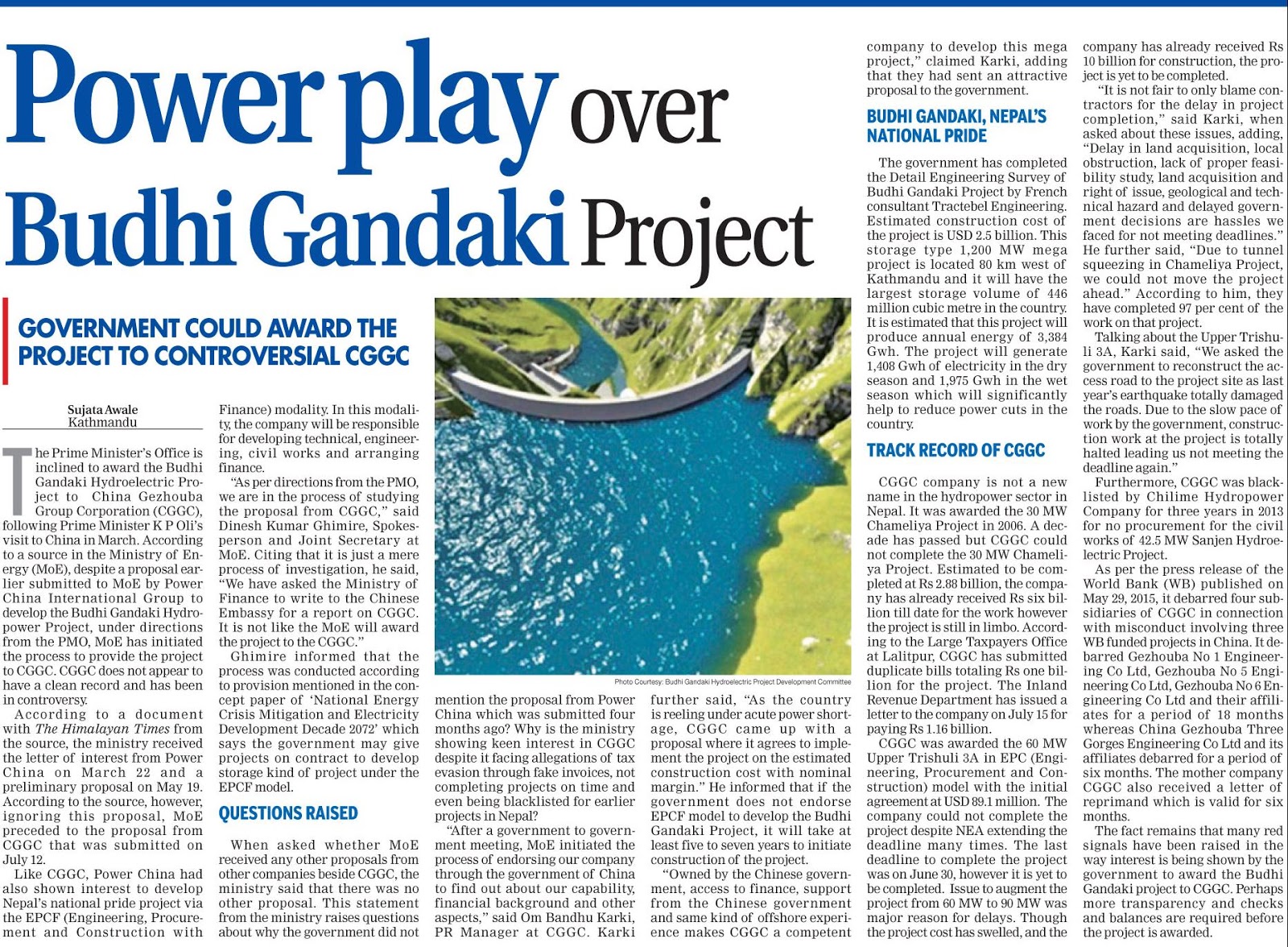
Estimated construction cost of the project is USD 2.5 billion. This storage type 1,200 MW mega project is located 80 km west of Kathmandu and it will have the largest storage volume of 446 million cubic metre in the country.

It is estimated that this project will produce annual energy of 3,384 Gwh. The project will generate 1,408 Gwh of electricity in the dry season and 1,975 Gwh in the wet season which will significantly help to reduce power cuts in the country.

Track record of CGGC 

CGGC company is not a new name in the hydropower sector in Nepal. It was awarded the 30 MW Chameliya Project in 2006. A decade has passed but CGGC could not complete the 30 MW Chameliya Project. Estimated to be completed at Rs 2.88 billion, the company has already received Rs six billion till date for the work however the project is still in limbo. According to the Large Taxpayers Office at Lalitpur, CGGC has submitted duplicate bills totaling Rs one billion for the project. The Inland Revenue Department has issued a letter to the company on July 15 for paying Rs 1.16 billion.

CGGC was awarded the 60 MW Upper Trishuli 3A in EPC ( Engineering, Procurement and Construction) model with the initial agreement at USD 89.1 million. The company could not complete the project despite NEA extending the deadline many times. The last deadline to complete the project was on June 30, however it is yet to be completed. Issue to augment the project from 60 MW to 90 MW was major reason for delays. Though the project cost has swelled, and the company has already received Rs 10 billion for construction, the project is yet to be completed.

“ It is not fair to only blame contractors for the delay in project completion,” said Karki, when asked about these issues, adding, “ Delay in land acquisition, local obstruction, lack of proper feasibility study, land acquisition and right of issue, geological and technical hazard and delayed government decisions are hassles we faced for not meeting deadlines.” He further said, “ Due to tunnel squeezing in Chameliya Project, we could not move the project ahead.” According to him, they have completed 97 per cent of the work on that project.

Talking about the Upper Trishuli 3A, Karki said, “ We asked the government to reconstruct the access road to the project site as last year’s earthquake totally damaged the roads. Due to the slow pace of work by the government, construction work at the project is totally halted leading us not meeting the deadline again.” Furthermore, CGGC was blacklisted by Chilime Hydropower Company for three years in 2013 for no procurement for the civil works of 42.5 MW Sanjen Hydroelectric Project.

As per the press release of the World Bank ( WB) published on May 29, 2015, it debarred four subsidiaries of CGGC in connection with misconduct involving three WB funded projects in China. It debarred Gezhouba No 1 Engineering Co Ltd, Gezhouba No 5 Engineering Co Ltd, Gezhouba No 6 Engineering Co Ltd and their affiliates for a period of 18 months whereas China Gezhouba Three Gorges Engineering Co Ltd and its affiliates debarred for a period of six months. The mother company CGGC also received a letter of reprimand which is valid for six months.

The fact remains that many red signals have been raised in the way interest is being shown by the government to award the Budhi Gandaki project to CGGC. Perhaps more transparency and checks and balances are required before the project is awarded.

(Published on The Himalayan Times, Perspectives, on July 31, 2016)

Saturday, July 16, 2016

Damaged monuments pose a threat

Indifferent authorities put people’s lives in danger

Sujata Awale
Photos by: Sujata Awale
Kathmandu

Kathmandu denizens are obliged to live in constant danger as the concerned authorities have not taken steps to protect them from vulnerable structures. More than a year has passed since the earthquake damaged and destroyed several buildings, monuments and structures. Due to negligence and slow pace of work even today many damaged structures pose a threat to locals and people passing by them.

A real threat 

One example is the Bhimsen Thapa Durbar at Lagan Tole. Last year’s earthquake led to the collapse of three fourth of the palace. The remaining portion is in a critical condition and could collapse any moment especially with the heavy rains now. The walls of the palace have severe cracks and the northern part is tilted. Two weeks ago, Kathmandu Metropolitan City constructed a surrounding walls, however, after heavy rainfall on July 1, the new wall on the northern part collapsed. Luckily nobody was injured or killed.

English Preparatory School ( EPS) located in the north escaped a tragedy, as the palace could have collapsed on top of the school premises. “ The damaged Bhimsen Thapa Durbar poses a constant risk to 300 school students and staffs. Why the government has not demolished such a vulnerable structure is an answer we are demanding,” said Nirmala KC, a non- teaching staff at EPS who also lives on the school premises. According to her, there are three schools — Gautam High School, EPS and Green Peace School in the locality plied by school- goers in and the road section is one of the busiest that leads to Sundhara.

Whose job is it anyway?

Bhimsen Thapa Durbar is public property under the Nepal Army’s Gyarijun Gaan. “ After heavy rainfall, a landslide took place and the constructed wall collapsed.

The northern part of the palace has parted and tilted more than before,” informed an army officer deployed at the palace. He further warned that the building can collapse anytime as rainfall makes it more dangerous. But even the army is helpless. “ This Durbar is a public historic monument that falls under the jurisdiction of the DoA. Being a historic monument, our hands are tied,” said Brigadier General Tara Bahadur Karki, Spokesperson at Nepal Army. According to him, they have written to the concerned department about the status of the building.

The status of the Mangalbazar Police Station building is no different. The government pasted a red sticker on it after quick assessment of the building. The threestorey building has severe cracks and is smack in the middle of a busy road in Patan. As a temporary solution, the police station functions from a tent in front of the building. “ We are aware of the risk that the building poses to the general public as well as police officers working here,” said Resham Bohara, Police Inspector at Mangalbazar Police Station.

He further said, “ As this building is at a World Heritage Site, Lalitpur Sub- Metropolitan City Office needs to take permission from the DoA in order to demolish or retrofit the building.” According to him, they got a letter to empty the building from the municipality and also to assist with manpower to demolish the building. However, he said that they are yet to decide and analyse available human resource to demolish the building.
According to him, Three Star Club is still using the building. Citing that the status of Police stations in other locations are also pathetic, he said, “ Police stations lack proper infrastructure and we are obliged to reside in temporary shelters or in makeshift tents.”

Real risks 

These two are just examples. There are hundreds of monuments, buildings, structures, temples, private properties damaged by the earthquake that pose a risk. It is clear that the state of such partially damaged structures is worsening day by day. However, the concerned authority DoA is in no hurry. Even after a year it has not even started structural analysis of partially damaged monuments.

“ Due to lack of resources and technical expertise, we are not able to conduct structural analysis of damaged monuments ,” said Damodar Gautam, Chief Archaeological Officer at DoA. He further said, “ We agree that it is already late for reconstruction of monuments.
But it doesn’t mean that DoA is not working. We are making a detailed documentation of partially and completely damaged monuments with drawings.” According to him, World Heritage Sites are their top priority and focus is on their documentation and study. On the status of Bhimsen Durbar, he said, “ We have conducted a preliminary study after the earthquake but at that time due to lack of resources we could not do anything.” He further said that he will deploy staff for site inspection to report the current status and as a preliminary mitigation option they will keep wooden beams as support and curtains to protect the building.

When asked on the plans for the building, he said, “ I cannot say it right now without the site inspection report. But we will take care of the property and make sure their won’t be any human casualty. If necessary, we will demolish the building.” According to him, they have Rs 340 million for reconstruction of monuments and till date they are in the bidding process for reconstruction of 49 monument projects.

Dr Sudha Shrestha, Professor, Department of Architecture and Urban Planning at the Institute of Engineering, said, “ It is already too late to manage or demolish vulnerable structures that pose a constant threat to the city dwellers. While city dwellers have to live with the threat everyday, it shows the failure of the government.” She added “ It has already been a year after the earthquake and the Department of Archaeology is still doing nothing about vulnerable structures.” Citing that the process of documentation of cultural and heritage buildings and temples takes time, she said, “ However, it does not mean that the government should take forever to demolish or retrofit such structures. In this emergency, the DoA in associated with NRA has to introduce required Emergency Policy to work on fast track.”


Published on July 17, 2016, The Himalayan Times, Perspectives

http://epaper.thehimalayantimes.com/epaperpdf/1772016/1772016-md-hr-17.pdf 

Sunday, July 10, 2016

“ I’m excited about the partnership and there are more opportunities”

Mary Hawkins, President of Bellevue University US, has established herself as a leader and national voice in higher education since joining the university in 1995. Before becoming University President in 2009, Hawkins served as Vice President of Enrollment and Outreach until 2000. She visited Kathmandu for the signing of an agreement between Himalayan Education Network and Bellevue University. She talks to Sujata Awale of THT Perspectives about the agreement and plans for Nepal. Excerpts:


How has Bellevue University’s journey been so far?

We are celebrating our 50 th year and there has been lot of changes in education over the last 50 years, but the core value of the university staff and faculty has remained the same; it’s always been about the students and their success. At Bellevue University, our students are mostly studying business, technology and healthcare. We try very hard to make sure that the degrees they are earning are the ones that lead to good jobs. Besides college experience most students care about career opportunities in the future. They want to build their future.

How will the MoU signed benefit Nepali students? 

Our hope is that students in Nepal in the Himalayan Education Network who wish to earn the US Bachelor’s degree can now easily transfer to Bellevue University and take a four- year programme that builds on what they have learnt. We are especially looking at health care, business and computer science right now but there are other choices if we grow the partnership but we want a start with leveraging what the students are learning here. The other thing that will happen for the students of Bellevue is they will be students from not only the United States but also from many other countries. We have students from 70 countries studying in Bellevue and we try very hard to connect the students with employers in the area. There are some major employers and they not only learn their academic subjects but they also benefit from learning and experiencing US business scenario. And sometimes that leads to internships and to jobs. It is a robust experience.

What is the significance of this MoU? 

There’s basically the agreement to transform the education from Nepal and recognise level 12 here as equivalent to a US level 12 to find a smooth transfer in admission, visa and other documents and to make everything very efficient for students here. We are going to the US Embassy here to explain what we are doing so that they understand and support the partnership we have. The other thing that we are looking at is some financial opportunities and scholarship opportunities even though we don’t have everything ironed out.

I think one exciting thing is visiting professorships to share the teachings in US and teachings in Nepal and have faculty exchange. It will also be beneficial to students who don’t come to the US to study because their professors will have some experience from US. It will also be good for our professors from the US to get to learn about how Nepali education and the Himalayan Education Network works.

How many students enroll in Bellevue University from Nepal? What are the basic requirements a student should meet to pursue a degree in the university? 

We’ve had about 600 Nepali students over time. In total we have around 13,000 students. We have different centres so some of the students study at other centres. We also have online learning options and we have many students enrolled in those.

To be eligible to enroll in our university, the students certainly need to have a proficiency in English, because they’ve got to be able to keep up with the studies, the standards that the international students have and the same as the standard of US students. The other thing I think would be attention to basics, the fundamental classes. The Nepali education system is different from some of the international schools we work with and what I like about teaching here is that there is a lot of group discussions, group work and team projects which is similar to how we do it in the US. In the US it is not just lecture and test, it’s the types of things that you do here. So I think it would make for a smooth transition.

Photos: Bikesh Shrestha/ THT

How is your university different from the others in the US?

Most universities in the US are in the public domain and classes are conducted in larger groups sometimes in a lecture hall with three to four hundred students whereas our professors work in classes with a smaller number of students.

The second is the fact that we are private, and we are able to respond to the students’ needs quickly. We can adopt to new technologies and new methods of teaching or experiment with a new programme faster than the public universities which have to go through a lot of government approvals.

We are credited by the United States Department of Education but because our budget is separate from the government budget we have a little more flexibility and that is important. One of the fortunate things about a private university environment is professors like to teach in private institutes because there is not so much red tape.

One of the important things about Bellevue University is that we encourage students to come and study and finish their degree; but we also want them to return to Nepal and apply their learning and build their economy and the country.

What are your future plans for Nepal? 

One is to get the agreement actually materialised with all of the procedures and processes and to work with the US embassy. Another is to identify curriculum paths. It’s figuring out how and what additional programmes to line up. I’m excited about the partnership and as we talk there are more opportunities that we are not thinking about now. We will start with basics and I have a feeling that will grow and take on a different path. That will be interesting and beneficial here and in the US.


(Published on THT Perspectives, July 10, 2016)